

The NASCAR qualifying format is one of the most debated and exciting aspects of the sport. Before the green flag drops on Sunday, drivers must set their positions through time trials, group sessions, or unique race formats. With the 2025 NASCAR season, major changes have been introduced — including a return to single-lap time trials at most tracks.
Whether you’re a long-time fan or new to the Cup Series, this guide breaks down everything you need to know about NASCAR qualifying in 2025, including the latest rules, track-by-track formats, and why Daytona 500 qualifying is unlike anything else in motorsports.
NASCAR Qualifying 2025: What Changed?
In December 2024, NASCAR announced significant revisions to qualifying procedures for the 2025 season. These changes were made to streamline race weekends and simplify formats for fans and teams.
Key 2025 Changes:
- Single-lap qualifying: Most oval tracks now use a single timed lap instead of two.
- Short tracks & intermediate ovals: Some venues allow two laps, with the fastest one counting.
- Superspeedways (Daytona & Talladega): Remain single-car qualifying but with two rounds.
- Road courses: Continue with group qualifying due to track length and layout.
- Daytona 500: Keeps its iconic “Duel” races to finalize the field.
How NASCAR Qualifying Works (Step by Step)
While formats differ by track, the basics of qualifying can be broken down into these steps:
- Practice Sessions → Drivers test setups, gather data.
- Qualifying Rounds → Laps are timed individually or in groups depending on the venue.
- Pole Awarded → Fastest driver earns pole position (P1).
- Starting Order Set → Positions 2–40 are filled based on lap times (or duel finishes at Daytona).
Track-Specific Qualifying Formats
🔹 1. Standard Oval Tracks (Most of the Schedule)
- Format: Single timed lap (new for 2025).
- Rounds: One.
- Result: Fastest lap = pole.
🔹 2. Short Tracks (Bristol, Martinsville, Richmond)
- Format: Two timed laps, fastest counts.
- Why? Shorter lap times allow multiple attempts.
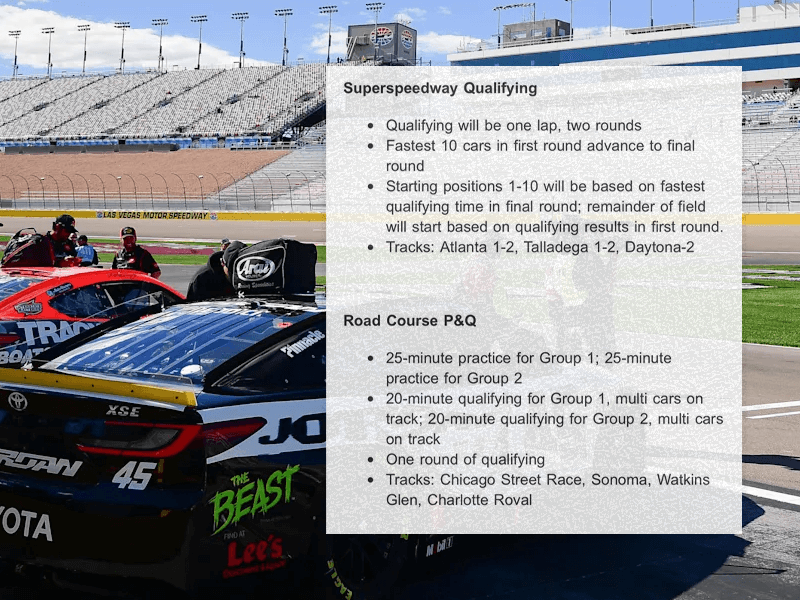
🔹 3. Superspeedways (Daytona & Talladega)
- Format: Single-car, two-round system.
- Round 1: All cars take one lap.
- Round 2: Top 10 fastest advance for another single lap.
- Daytona 500 exception: Duels are added to determine much of the grid.
🔹 4. Road Courses (Sonoma, Watkins Glen, COTA, Chicago Street Course)
- Format: Group qualifying.
- Groups: Field split in half. Each group runs timed laps.
- Advancement: Fastest 5 from each group move to a “final 10” shootout.
The Daytona 500: Qualifying Like No Other
The Daytona 500, NASCAR’s “Super Bowl,” uses a unique multi-step system:
- Pole Day (Single Laps): Fastest two cars lock into the front row.
- Duel Races: Two 150-mile qualifying races set positions 3–40.
- Provisional Spots: Four non-charter drivers can race in through speed or duels.
This format adds drama, as qualifying at Daytona feels like its own mini-event.
Why Qualifying Matters in NASCAR
Unlike Formula 1, where pole position often predicts race winners, NASCAR races are long and strategy-heavy. Still, qualifying is crucial because:
- Pole position offers pit stall advantage.
- Track position is vital at short tracks and superspeedways.
- Clean air helps with car handling.
- Confidence boost: Drivers who qualify up front gain momentum.
Recent Examples of NASCAR Qualifying
- Kansas (Sept 2025): Chase Briscoe snagged pole with a blistering lap, showing how single-lap formats reward precision.
- Sonoma (June 2025): Road course qualifying created chaos with traffic and group runs.
- Daytona 500 (Feb 2025): Duels shook up the lineup, allowing smaller teams to make the race.
Strategy in Qualifying
Teams and drivers don’t just “go all out.” Strategy includes:
- Tire prep: Scuffing tires vs new rubber.
- Engine cooling: Managing temps between runs.
- Drafting: Superspeedway qualifying often bans drafting, but setups still matter.
- Timing: Going out early vs late depending on track temp.
FAQs on NASCAR Qualifying
How does NASCAR qualifying work in 2025?
Most tracks use a single timed lap. Short tracks allow two laps. Road courses use group formats, and superspeedways use two-round single-car runs.
Why did NASCAR change qualifying in 2025?
To simplify formats, reduce time, and improve fan understanding.
What makes Daytona qualifying unique?
It includes single-lap runs and the Duel races, making it a multi-day event.
Does pole position guarantee a win?
No. NASCAR races are long, with pit stops, cautions, and strategy often shuffling the order.
Who won the most poles in NASCAR history?
Richard Petty (123). Among active drivers, Kevin Harvick and Kyle Busch lead.
