

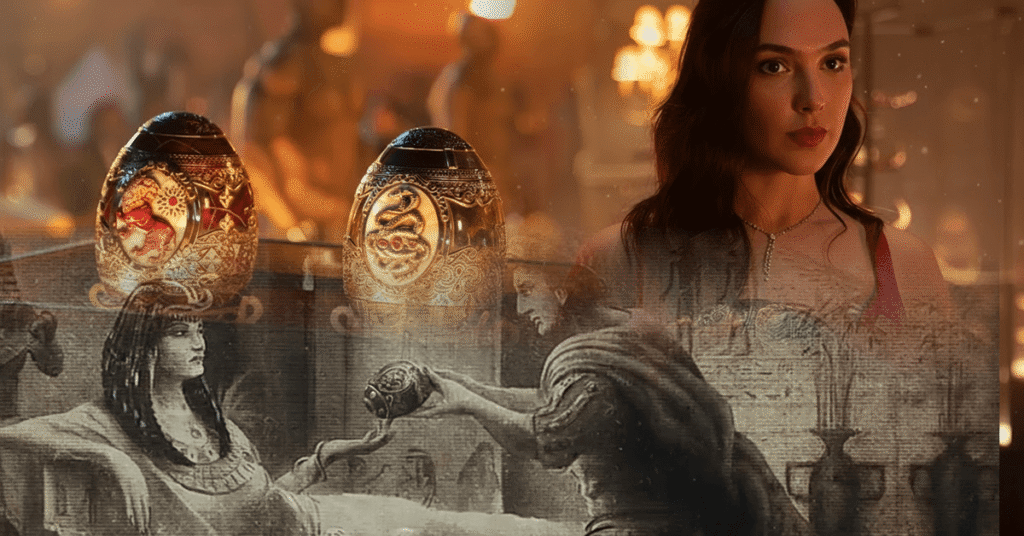
The Glittering Myth of Cleopatra Eggs: When Netflix released Red Notice starring Dwayne Johnson, Gal Gadot, and Ryan Reynolds, one object stole the spotlight as much as the actors themselves: the dazzling “Cleopatra’s Eggs.” In the movie, these three golden, jewel-encrusted treasures are presented as priceless artifacts once gifted by Mark Antony to Cleopatra, Queen of Egypt. But after the credits rolled, audiences worldwide had one pressing question: Are Cleopatra’s Eggs real?
The truth is far more fascinating than the fiction. Cleopatra’s Eggs may not exist in reality, but the myth they represent touches on history, ancient symbolism, and our collective obsession with legendary treasures. This article will dive deep into the origins of the story, debunk myths, explore historical context, compare them to Fabergé eggs, and even speculate what they might be worth if they were real.
What Red Notice Says About Cleopatra Eggs
The movie introduces Cleopatra’s Eggs as a trio of ornate treasures created more than 2,000 years ago. According to the plot, these eggs were a wedding gift from Mark Antony to Cleopatra, symbolizing eternal love. Over centuries, the eggs were lost to history, with one of them rediscovered by chance.
This Hollywood backstory set the stage for a thrilling global heist adventure—but it also blurred the lines between fact and fiction.
Key Fictional Claims in Red Notice:
- Three golden eggs existed, covered in jewels.
- They were gifted by Mark Antony to Cleopatra.
- Two are known to exist, while one was hidden and only recently resurfaced.
While entertaining, none of these claims hold historical weight.
Did Cleopatra Own Such Treasures? The Historical Reality
Cleopatra VII, the last active ruler of the Ptolemaic dynasty, lived a life of immense wealth and opulence. Ancient accounts describe her palaces, elaborate feasts, and political alliances sealed with gifts of gold, silver, and jewels.
However, there is no archaeological or textual record of Cleopatra ever possessing ornate eggs. Egyptian artifacts from her era include jewelry, coins, statues, and everyday luxury items—but nothing resembling the eggs depicted in Red Notice.
So where did the idea come from? The closest real-world counterpart is the Fabergé egg, a series of jewel-encrusted masterpieces created in the late 19th and early 20th centuries in Russia. The screenwriters likely drew inspiration from these objects, fusing them with Cleopatra’s legendary wealth to create a believable fictional treasure.
Fabergé Eggs: The Real Inspiration
Fabergé eggs were created by Peter Carl Fabergé for the Russian Tsars Alexander III and Nicholas II as Easter gifts for their wives and mothers. Between 1885 and 1917, about 50 Imperial eggs were made, each unique and intricately designed with gemstones, gold, and hidden surprises inside.
Comparison: Cleopatra’s Eggs vs. Fabergé Eggs
| Feature | Cleopatra Eggs (Red Notice) | Fabergé Eggs (Real) |
|---|---|---|
| Time Period | Ancient Egypt (c. 40 BCE) | Russia (1885–1917) |
| Materials | Gold, jewels (fictional) | Gold, diamonds, pearls, enamel, gemstones |
| Purpose | Gift from Mark Antony to Cleopatra | Easter gifts for Russian royalty |
| Number | 3 | ~50 Imperial eggs (65+ total, some lost) |
| Status | Fictional | Real, museums & private collections |
The blending of Cleopatra’s image with Fabergé eggs was a brilliant cinematic choice: it felt plausible, luxurious, and mysterious—perfect for a heist film.
Symbolism of Eggs in Ancient Cultures
While Cleopatra never owned jewel-encrusted eggs, eggs did hold symbolic meaning in ancient civilizations:
- Egyptian Mythology: The “cosmic egg” represented creation and rebirth. In some myths, the sun god Ra emerged from a cosmic egg.
- Greek Influence: Cleopatra’s dynasty was Macedonian Greek (the Ptolemies), and in Hellenistic culture, eggs often symbolized fertility and life.
- Roman Traditions: Eggs were associated with renewal and used in burial practices.
Thus, even though the physical eggs are fictional, the symbolism aligns with themes of fertility, immortality, and legacy—fitting for a queen like Cleopatra.

If Cleopatra’s Eggs Were Real: What Would They Be Worth?
One of the reasons people are fascinated by Cleopatra’s Eggs is the imagined value. Let’s speculate:
- Historical Provenance: Artifacts linked to Cleopatra fetch astronomical prices due to rarity. A single coin with her likeness can sell for thousands of dollars.
- Design Value: If crafted like Fabergé eggs with gold and precious gems, each egg could easily be worth tens of millions.
- Cultural Value: With the Cleopatra legend attached, the price could skyrocket.
Estimated Value: Experts suggest that if Cleopatra’s Eggs existed, each could easily surpass $100 million, putting the trio in the same category as the world’s most expensive treasures.
Pop Culture Power: How Red Notice Shaped the Myth
Before Red Notice, no one had heard of Cleopatra’s Eggs. But thanks to Netflix’s global reach, millions of viewers believed—at least briefly—that the eggs were real. This phenomenon highlights how pop culture can create modern myths, blending truth and fiction in ways that confuse and captivate audiences.
Other examples include:
- Indiana Jones’ “Ark of the Covenant” (real but dramatized).
- The “Heart of the Ocean” diamond in Titanic (fictional but inspired by real stones).
- The Elgin Marbles, often dramatized in films and novels.
FAQs About Cleopatra’s Eggs
Q1: Are Cleopatra’s Eggs real?
No, Cleopatra’s Eggs are fictional, created for the 2021 film Red Notice.
Q2: How many Cleopatra’s Eggs are there?
In the movie, there are three. In reality, none exist.
Q3: Were they inspired by real artifacts?
Yes, likely by Fabergé eggs, created in Russia centuries after Cleopatra’s time.
Q4: Did Cleopatra own treasures?
Yes, she owned vast riches, but none in the form of ornate eggs.
Q5: What is the symbolic meaning of eggs in Egyptian culture?
They represented creation, fertility, and renewal.
Q6: How much would Cleopatra’s Eggs be worth if real?
Likely hundreds of millions of dollars, due to historical and cultural significance.
Conclusion: Myth, Movie, and Memory
Cleopatra’s Eggs may not be real artifacts, but their story reflects something deeper: humanity’s fascination with wealth, beauty, and mystery. By combining ancient legend with modern imagination, Red Notice created a treasure that feels as real as history itself.
The truth? Cleopatra’s legacy lies not in jeweled eggs but in her intelligence, political power, and the cultural footprint she left on the world. Yet the myth of Cleopatra’s Eggs proves that sometimes, even fiction can sparkle with the allure of truth.
